

Can Do Statements

Building Confidence Through Clear Progress.

Can Do Statements help learners understand what they are able to do at each stage of language development. They provide clear, practical examples of real-world skills, making it easier for learners to recognize progress, set goals, and build confidence. Through simple and learner-focused statements, users can better understand their strengths, identify next steps, and apply language skills in everyday life, education, and work.


Connecting CLB Skills with Real-World Workplace Examples

The language skills of Listening, Speaking, Reading, and Writing align the CLB with each SFS level and provide examples of language used in a workplace setting.

There are four can do statements for each CLB level. Each statement aligns with one of the four competency areas in the CLB. There is a corresponding example for each Can Do Statement. For CLB 1-2 the examples use illustrations to facilitate comprehension at these levels. CLB Skills and competency areas:
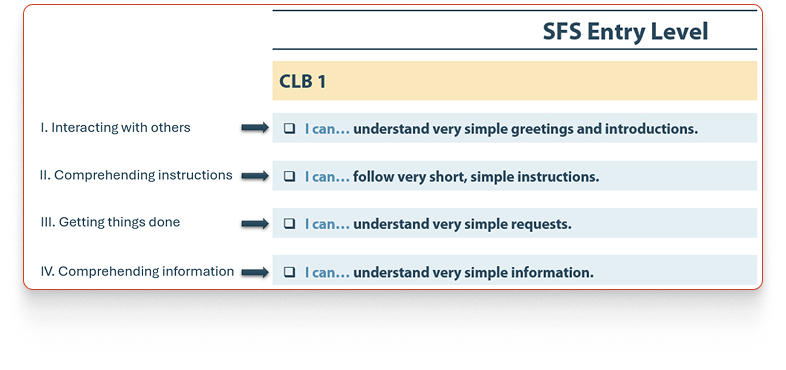
Listening

I. Interacting with others
II. Comprehending instructions
III. Getting things done
IV. Comprehending information

Speaking

I. Interacting with others
II. Giving instructions
III. Getting things done
IV. Sharing information

Reading

I. Interacting with others
II. Comprehending instructions
III. Getting things done
IV. Comprehending information

Writing

I. Interacting with others
II. Reproducing information
III. Getting things done
IV. Sharing information

Connecting CLB Stages with Skills for Success in Workplace Contexts

The skills of Adaptability, Collaboration, Creativity and Innovation, Digital, Numeracy, and Problem Solving align the CLB stage with the SFS components and provide examples of language used in that context in a workplace setting.

For the non-language skills, it is broken out by Stage. In each stage, there are six Can Do Statements. Each of these aligns with one of the six components in the SFS framework. There is a corresponding example for each Can Do Statement. For Stage I, the examples use both text and illustrations to facilitate comprehension for these language levels.

Adaptability

  1. Demonstrate responsibility
  2. Persist and persevere
  3. Regulate your emotions when appropriate
  4. Set or adjust your goals and expectations
  5. Plan and prioritize
  6. Seek self-improvement

Collaboration

  1. Work well with other people
  2. Value diversity and inclusivity of others
  3. Manage difficult interactions with other people
  4. Facilitate an environment where you can collaborate with others
  5. Achieve a common goal with others
  6. Achieve a common goal with others

Creativity and
Innovation

  1. Use your imagination and curiosity
  2. Identify opportunities for you to innovate
  3. Generate ideas that are novel to yourself or others
  4. Develop your ideas
  5. Apply your ideas
  6. Facilitate a creative and innovative environment for yourself and others

Digital

  1. Use digital devices including computers, tablets, smart phones, and other
    handheld devices
  2. Use common digital tools to complete tasks
  3. Use digital information
  4. Use online tools and platforms
  5. Apply safe and responsible practices online
  6. Update and upgrade digital skills

Numeracy

  1. Identify the task that will require you to use numeracy
  2. Identify the mathematical information
  3. Make connections between related pieces of mathematical information
  4. Apply mathematical operations and tools you will need to answer the question
  5. Interpret and evaluate the information
  6. Share the mathematical information, results and implications

Problem Solving

  1. Identify the issue to address
  2. Gather information to help you address the issue
  3. Analyze the issue
  4. Develop multiple routes of action
  5. Address the issue
  6. Evaluate the effectiveness of the solution or decision

Explore Resources

They can be used by:

  • Learners and employees to help them understand what they have already accomplished, and find information to support them as they set their next language learning goals.
  • Instructors and program developers as a guide for developing authentic tasks for the training and assessment of learners.
  • Instructors and program developers as an informal check for the achievements of learners and to support goal setting.
  • Employers to better understand the workplace language needs of employees.

The LFS Can Do Statements cannot be used for formal language assessment because they do not include any test prompts, items, or indicators. The tool does not include the level of detail needed to support formal language assessment.