Reading

Building Understanding Through Meaningful Text.

Reading helps learners understand written information, build vocabulary, and develop confidence in using language for real-world situations. It supports meaningful language development by strengthening comprehension, interpretation, and critical thinking skills needed for everyday life, education, and work. Through practical and learner-focused reading activities, learners can access information more effectively and continue building independence at every stage of their language journey.

Reading Skills

Skills for Success defines Reading as the ability to find, understand, and use information presented through words, symbols, and images.

See how SFS Reading relates to CLB Reading 

Skills for Success (SFS) is a national framework that identifies nine key skills Canadians need for work, learning and life. The Language for Success framework uses the SFS definitions and levels as conceptualized by the Government of Canada. The number of levels varies by skill. SFS Reading is organized into five proficiency levels.

The Canadian Language Benchmarks (CLB) describe communicative ability in English as a Second Language (ESL). The CLB organize 12 benchmarks into three stages of ability: Stage I (Basic), Stage II (Intermediate) and Stage III (Advanced).

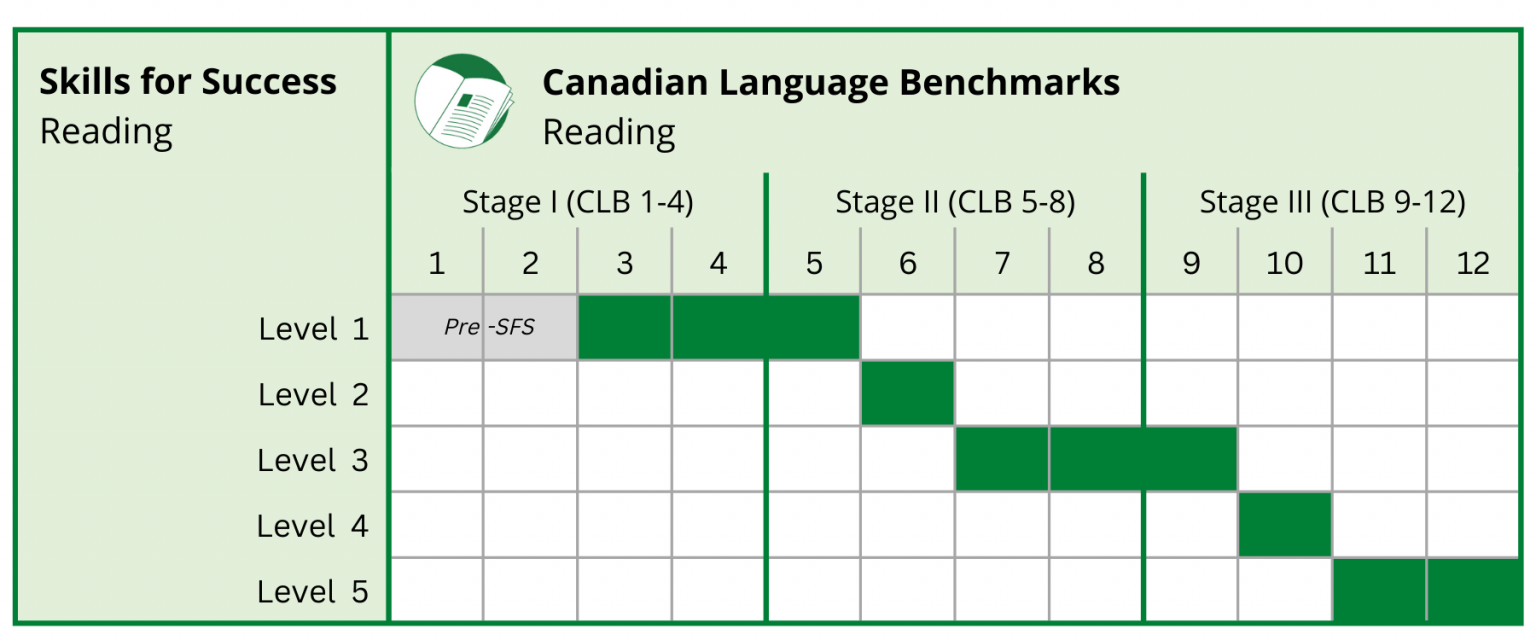
The shading in the table shows how the SFS Reading levels relate to the CLB Reading benchmarks. Pre-SFS refers to benchmarks that fall below SFS Reading Level 1. The relationship was first established through a study led by the Centre for Canadian Language Benchmarks in 2005.


Explore what a person can do at each Reading benchmark

CLB 1-2 relates to Pre-SFS

CLB 1

Read the alphabet and common simple, words with the help of pictures.

For example, at work:

  • Check the expiration date on milk in the staff room fridge.

  • Identify where to write name and address on a simplified form.

  • Read a simple warning sign. (No smoking.)


CLB 2

Read the alphabet, common words and very simple sentences on familiar topics with the help of pictures.

For example, at work:

  • Review an invoice to locate due date and amount to be paid.

  • Read a simple note. (Washroom closed for cleaning.)

  • Read a simple two-step instruction for a work task. (Make 10 copies. Mail to client.)

CLB 3-5 relates to SFS Level 1

CLB 3

Read and understand simple, everyday words and basic information from simple, short paragraphs with the help of visuals.

For example, at work:

  • Read a short suggestion submitted through an online comment form.

  • Read a brief email from a co-worker to identify the time, location and purpose of a meeting.

  • Follow instructions with visuals on how to sanitize a food preparation area.

  • Read a description of an item in an online catalogue.


CLB 4

Understand short simple paragraphs about familiar topics, and some longer descriptions about less familiar topics.

For example, at work:

  • Read and follow instructions for handwashing techniques to reduce the spread of germs.

  • Read basic safety rules on a workplace poster.

  • Read a schedule to identify work shifts.

CLB 5

Understand the main ideas, some details, and some implied meaning in texts on somewhat familiar topics, and begin to get information from more difficult texts.

For example, at work:

  • Read a brochure about employment standards.

  • Interpret a memo about changes to a workplace policy.

  • Read and follow instructions for use and identify precautions for a hazardous product.

CLB 6 relates to SFS Level 2

CLB 6

Understand the purpose, some main points and details from longer, more difficult texts, and begin to understand the writer’s intent and attitude.


CLB 7-9 relates to SFS Level 3

CLB 7

Find and integrate different ideas, or compare and contrast information in a range of reading materials that may deal with facts, opinions and feelings.

CLB 8

Integrate information, understand implied meanings and the writer’s intention in texts that are long and a little difficult, and that may address more abstract topics.

CLB 9

Understand an adequate range of complex texts on some unfamiliar topics and in contexts that may require significant interpretation.

CLB 10 relates to SFS Level 4

CLB 10

Understand an expanding range of complex multipurpose texts on many unfamiliar topics and in contexts that may require significant interpretation.

CLB 11-12 relates to SFS Level 5

CLB 11

Understand an expanded range of complex multipurpose texts on most unfamiliar topics and in contexts that may require significant interpretation.

CLB 12

Understand complex, unfamiliar, multipurpose texts in a broad variety of styles and formats across a range of situations and contexts that are unfamiliar and may require significant interpretation.