





Communication

Building Confidence Through Meaningful Communication.

Communication helps learners express ideas clearly, understand others more effectively, and build confidence in real-world interactions. It supports meaningful language development by strengthening speaking, listening, and interpersonal skills that are essential for everyday life, education, and work. Through a practical and learner-focused approach, communication fosters connection, clarity, and greater success at every stage of the language journey.

Communication Skills

Skills for Success defines Communication as the ability to receive, understand, consider, and share information and ideas through expressive, receptive, and interacting with others.

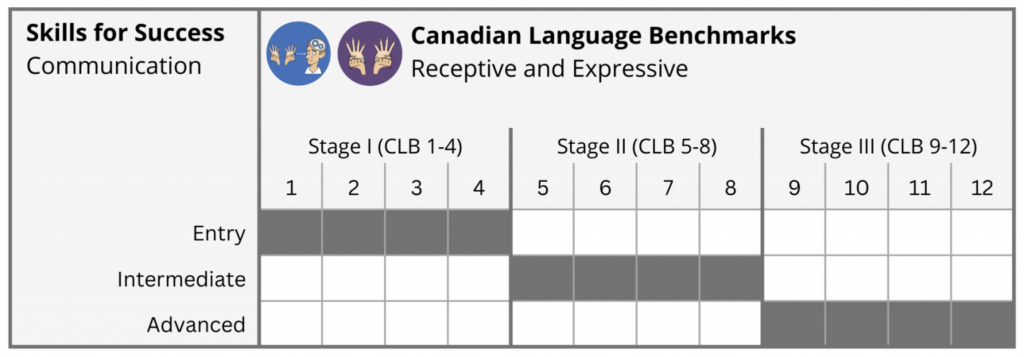
See how SFS Communication relates to CLB Receptive and Expressive

Skills for Success (SFS) is a national framework that identifies nine key skills Canadians need for work, learning and life. The Language for Success framework uses the SFS definitions and levels as conceptualized by the Government of Canada. The number of levels varies by skill. SFS Communication is organized into three proficiency levels: Entry, Intermediate and Advanced.

The Canadian Language Benchmarks (CLB) describe communicative ability in English as a Second Language (ESL). The CLB organize 12 benchmarks into three stages of ability: Stage I (Basic), Stage II (Intermediate) and Stage III (Advanced).

The shading in the table shows how the SFS Communication levels relate to the CLB Receptive and Expressive.

“Receptive” and “Expressive” are the terms used in the Canadian Language Benchmarks for the Deaf (CLBD). CCLB understands that other terms such as “Interpretive” and “presentational” may be used elsewhere.

Explore what a person can do at each Receptive and Expressive benchmark

CLB 1-4 relates to SFS Entry level

CLB 1

Understand a limited number of simple and familiar words and phrases.

For example, at work:

  • Follow a very short direction when a gesture is used to support it. (The bathroom is over there. Take it upstairs.)

  • Recognize a request for attention. (Excuse me.)

  • Follow a simple command or instruction. (Please sit down.)

CLB 2

Understand some simple and familiar words, phrases and short sentences.

For example, at work:

  • Recognize a short request. (How do you fingerspell your name?)

  • Understand a short simple safety warning. (Do not use the stairs.)

  • Follow simple instructions. (Put the date here. Sign on this line.)

CLB 3

Understand short sentences and some simple questions about familiar, everyday topics.

For example, at work:

  • Understand a co-worker’s request to switch a shift.

  • Get the gist of a short simple announcement about a company event.

  • Follow directions to a department or floor of a building.


CLB 4

Understand simple information and questions about familiar, everyday topics.

CLB 1

Greet people and give some simple information about themselves, using only a few words.

For example, at work:

  • Fingerspell your name to a co-worker.

  • Give a very simple short command or instruction. (Open the door.)

  • Ask for assistance by saying, “Please help me.”

  • Use common signed expressions, “How are you?” and “I am fine.”


CLB 2

Greet people and give some simple information about themselves, using short sentences.

For example, at work:

  • Introduce yourself to a new co-worker and respond to their introduction.

  • Place a simple order. (Coffee with milk, please.)

  • Request to borrow an item from a co-worker.

  • Give a simple command or instruction. (Please don’t answer the video relay service (VRS) call.)


CLB 3

Say a few simple sentences about familiar, everyday topics, needs and experiences.

For example, at work:

  • Greet a customer and exchange pleasantries.

  • Ask a supervisor for permission to leave early.

  • Ask simple questions to learn about a new co-worker.

  • Give simple directions to a new co-worker to help them find the lunchroom.


CLB 4

Give simple information about common everyday activities, experiences, needs and preferences.

CLB 5-8 relates to SFS Intermediate level

CLB 5

Understand with some effort the overall meaning, including some implied meanings when someone signs about familiar topics.

For example, at work:

  • Watch and understand a discussion amongst co-workers about their preferences for a meeting time and reasons for their preferences.

  • Watch and understand a text message from a co-worker who is asking to switch shifts.

  • Follow instructions on how to use a piece of machinery.

  • Read an announcement with straightforward instructions for evacuating a building

CLB 6

Follow the important details and understand some unfamiliar words, common idioms, and implied meanings when someone signs about familiar topics.

For example, at work:

  • Understand a short awareness video about basic safety procedures at work.

  • Understand routine questions from a customer about a product in order to provide information.

  • Watch and understand a supervisor give instructions over the video relay service (VRS) or text.


CLB 7

Understand the main points, important details and implied meanings when others discuss familiar topics and some abstract concepts related to general knowledge and life experience.

For example, at work:

  • Watch and understand a discussion amongst co-workers about a new policy, and understand their attitudes.

  • Understand a safety expert describe how to handle a new dangerous material at work to determine appropriate actions.

  • Watch and understand a supplier’s response to a question about a product’s uses and availability.

  • Watch and understand a work status update from a co-worker during a shift change.


CLB 8

Understand the main points, details, purpose, attitude and implied meanings when others discuss familiar topics and a range of abstract concepts related to general knowledge, life experience and work-related situations.

CLB 5

Communicate in short, routine social and work situations, using some longer sentences.

For example, at work:

  • Respond to a routine request from a customer by the video relay service (VRS).

  • Make a simple suggestion for how to improve sales on days of the week when business tends to be slower.

  • Place an order for goods with a supplier.


CLB 6

Communicate in everyday situations using some complex sentence structures to connect ideas.

For example, at work:

  • Apologize for arriving late to a team meeting and provide an explanation.

  • Decline an invitation to a team-building social activity and provide a reason you cannot attend.

  • Communicate or chat with co-workers to coordinate the use of equipment.


CLB 7

Sign comfortably on many familiar topics, including expressing opinions, feelings and reservations, and making detailed comparisons.

For example, at work:

  • Sign to a supervisor about dissatisfaction with a work schedule.

  • Give instructions to a new co-worker on options available if a customer wants to return a product.

  • Give a detailed suggestion for how to solve a problem or make an improvement.

  • Participate in a union meeting to discuss working conditions.


CLB 8

Sign comfortably about a range of topics, providing descriptions, opinions and explanations, and recommending solutions to problems.

CLB 9-12 relates to SFS Advanced level

CLB 9

Understand an adequate range of complex formal and informal communication on a broad variety of general interest topics, and on some specialized topics in own field.

For example, at work:

  • Watch a recording from a web-based meeting to prepare meeting minutes.

  • Watch and understand a panel discussion to identify ways of modifying the work environment to meet the needs of individuals with disabilities.

  • Watch and understand a discussion amongst co-workers about how to address job vacancies during a meeting to identify opinions, strengths, and limitations.

  • Watch and understand detailed instructions and requests for information from police, fire department and medical staff during a workplace incident.


CLB 10

Understand an expanding range of complex, formal and informal communication, across a range of situations and contexts that may require significant interpretation.

For example, at work:

  • Watch and understand a candidate’s responses to interview questions to evaluate suitability for the job.

  • Watch and understand detailed descriptions of multiple equipment failures over time to identify the root cause and possible solutions.

  • Watch and understand and evaluate a presentation delivered by a potential consultant outlining how they propose to solve a procedural issue.


CLB 11

Understand an expanded range of complex, formal and informal communication across a range of situations and contexts that may require significant interpretation.

For example, at work:

  • Watch and understand a co-worker recount a conflict with a manager and identify the attitudes and behaviours that contributed to the conflict.

  • Watch and understand a lecture presenting research findings at a professional conference.

  • Watch and join in focus group participants’ responses to understand and analyze views on a complex social issue and identify ways to probe for additional insights.

  • Watch and understand a variety of professionals giving assessments of a proposed large-scale equipment purchase, including a cost-benefit analysis and projected impacts on the workforce, to decide whether to proceed.

CLB 12

Understand an extensive range of complex, abstract formal and informal communication across a range of situations and contexts that may require significant interpretation.

CLB 9

Sign and converse with some confidence in situations that require diplomacy, tact and precision, and present information about complex, abstract and general topics.

For example, at work:

  • Provide detailed instructions to a client over the video relay service (VRS) to resolve a technical issue.

  • Co-facilitate a staff meeting, clarifying information as needed and ensuring that everyone has an opportunity to contribute.

  • Discuss a new project with a recently established team to identify activities, timelines and task assignments.

  • Make a presentation to co-workers to share the results of a survey and provide evidence to support a set of recommendations.


CLB 10

Sign and converse with increasing confidence in situations that require diplomacy, tact and precision, and present information about complex, abstract and general topics.

For example, at work:

  • Respond appropriately to sarcastic or patronizing remarks from others in a meeting.

  • Present skills, abilities and experience in an interview, fielding questions with detailed responses to convince the panel of your suitability for the job.

  • Deliver training to co-workers on a new practice or procedure.


CLB 11

Sign and converse comfortably in situations that require diplomacy, tact and precision, and present information about complex, abstract and general and specialized topics.

For example, at work:

  • Negotiate a long-term, large-scale agreement with a vendor.

  • Make an extended, formal presentation to a board of directors to propose a major change in an organization’s direction.

  • Lead a problem-solving session with an interdisciplinary team of professionals who bring diverse perspectives.

CLB 12

Sign and converse with confidence in situations that require diplomacy, tact and precision, and present information about complex, abstract and general and specialized topics.