


Writing

Writing

Building Confidence Through Clear Expression.

Writing helps learners organize ideas, share information clearly, and communicate with confidence in real-world situations. It supports meaningful language development by strengthening sentence structure, vocabulary, accuracy, and written communication skills needed for everyday life, education, and work. Through practical and learner-focused writing activities, learners can express themselves more effectively and build independence at every stage of their language journey.

Writing Skills

Skills for Success defines Writing as the ability to share information using written words, symbols, and images.

See how SFS Writing relates to CLB Writing
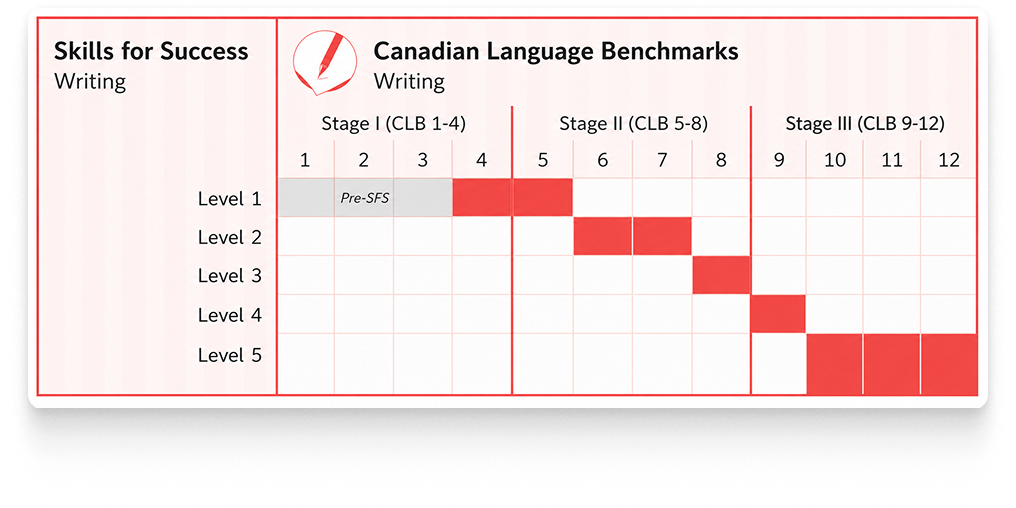
Skills for Success (SFS) is a national framework that identifies nine key skills Canadians need for work, learning and life. The Language for Success framework uses the SFS definitions and levels as conceptualized by the Government of Canada. The number of levels varies by skill. SFS Writing is organized into five proficiency levels.

The Canadian Language Benchmarks (CLB) describe communicative ability in English as a Second Language (ESL). The CLB organize 12 benchmarks into three stages of ability: Stage I (Basic), Stage II (Intermediate) and Stage III (Advanced).

The shading in the table shows how the SFS Writing levels relate to the CLB Writing benchmarks. Pre-SFS refers to benchmarks that fall below SFS Writing Level 1. The relationship was first established through a study led by the Centre for Canadian Language Benchmarks in 2005.

Explore what a person can do at each Writing benchmark

CLB 1-3 relates to Pre-SFS

CLB 1

Write a few common, everyday words.

For example, at work:

  • Sign a card for a co-worker’s birthday or retirement.

  • Copy a name and phone number from a business card to a contact list.

  • Fill out own name and address on a simplified form.


CLB 2

Write simple phrases and some very short, simple sentences about something very familiar.

For example, at work:

  • Copy a company name, address and representative contact information from a website.

  • Copy information from a work schedule into a planner or personal calendar.

  • Write a very short simple list of work tasks to be done.

CLB 3

Write short, simple sentences about something familiar.

For example, at work:

  • Write a short note to tell a colleague to lock the door before leaving.

  • Write an automatic email response to say you are on vacation and when you will be back.

  • Fill out an emergency contact form.

CLB 4-5 relates to SFS Level 1

CLB 4

Write a few simple sentences about a personal experience or a routine task.

For example, at work:

  • Write a list of tasks for a co-worker to carry out on the next shift.

  • Write notes to record work tasks completed during a shift using a handheld computer.

  • Write an email agreeing to a meeting request and giving your availability.

CLB 5

Write short messages or a paragraph with a main idea and some supporting details.

For example, at work:

  • Write an email to request a day off and provide a detailed reason for the request.

  • Write a description in a work order to identify repairs to be made.

  • Complete a checklist to indicate that a routine cleaning inspection has been conducted and write a description of deficiencies.

CLB 6-7 relates to SFS Level 2

CLB 6

Write short messages and texts with clearly expressed ideas and supporting details, using some complex sentence structures.

For example, at work:

  • Write a message to thank a colleague for an act of kindness with a description of its positive effect.

  • Take notes to remember key information from a short presentation.

  • Write step-by-step instructions for clearing a paper jam in a printer or photocopy machine.

  • Complete a leave request form to indicate the duration and reason for a leave.

CLB 7

Write messages or short well-organized texts about familiar, concrete topics, using some complex sentence structures to connect ideas.

CLB 6-7 relates to SFS Level 2

CLB 6

Write short messages and texts with clearly expressed ideas and supporting details, using some complex sentence structures.

For example, at work:

  • Write a message to thank a colleague for an act of kindness with a description of its positive effect.

  • Take notes to remember key information from a short presentation.

  • Write step-by-step instructions for clearing a paper jam in a printer or photocopy machine.

  • Complete a leave request form to indicate the duration and reason for a leave.

CLB 7

Write messages or short well-organized texts about familiar, concrete topics, using some complex sentence structures to connect ideas.

CLB 8 relates to SFS Level 3

CLB 8

Express ideas and opinions about familiar or abstract topics using clearly expressed paragraphs and some complex sentence structures to connect ideas.

For example, at work:

  • Complete a lengthy government form to report remittances.

  • Write a detailed incident report to describe events leading up to an accident.

  • Write a letter of apology to a client to explain how a problem occurred and to relate actions taken to avoid a recurrence.

  • Write a resume and persuasive cover letter in response to a job advertisement.

CLB 9 relates to SFS Level 4

CLB 9

Write formal and informal texts of some complexity for an adequate range of purposes and tasks in routine situations that may require tact, diplomacy and precision.

For example, at work:

  • Write a report to propose changes to operating procedures.

  • Write the minutes from a team meeting to share with others.

  • Write a detailed report that describes the objectives and procedures for testing a new product, discusses results and offers conclusions and recommendations.

  • Document a verbal agreement made with a client.

CLB 10-12 relates to SFS Level 5

CLB 10

Write complex formal and informal texts for a broadening range of purposes and tasks in mostly routine situations that may require tact, diplomacy and precision.

For example, at work:

  • Write a formal letter of apology for a serious workplace error.

  • Prepare an annual report to summarize a company’s activities and highlight successes.

  • Write a marketing plan detailing strategies and opportunities.

  • Write a business plan to detail strategic direction and steps to implementation.

CLB 11

Write complex formal and informal texts for a wide range of purposes and tasks in non-routine situations that may require tact, diplomacy and precision.

For example, at work:

  • Write a letter to inform a long-term supplier that their services are no longer required; craft the message so the supplier feels appreciated and sees opportunities for future collaboration.

  • Write a press release.

  • Write an article for a company newsletter to present an analysis of industry trends.

  • Write an executive summary of a longer report or study.

CLB 12

Write complex formal and informal texts for a full range of purposes, intentions and objectives related to non-routine, situations that may require tact, diplomacy and precision.

For example, at work:

  • Write a detailed proposal intended to secure a significant contract from a new client.

  • Create advertising campaign materials to describe features and benefits of a product, and to convey value for the target market.

  • Write an article to present research findings in a peer-reviewed journal.

  • Write a company policy manual.